One For the Price of Two
Marriage, family, and the power of “us”

Twenty years ago this summer, one of my very first clients moved her field trial horse to a little red barn on a sunny hillside in the Brandywine valley. I remember vividly the first time I shod the horse there: the sweat rolling off my face in the heat and humidity; the uncertainty and loneliness as I labored away without the encouragement and oversight of the man I’d been apprenticing with; the sense of adventure blending with the harsh reality that this was a hard way to earn a living; the relief I felt more than two hours later when, soaked and dirty, I extended a handwritten invoice to the owner and she handed back a check.
The memory of that day returned with tremendous force this morning, as the hot August sun looked down on Secundus and me, working together at the same little barn. The previous owner is long gone, the horses we shod were better behaved, but the barn itself hasn’t changed. The mercury climbed well past ninety degrees while we worked side by side, but the heat and the sweat weren’t enough to keep off the immense gratitude I felt just for being in that moment. I watched my son – who wasn’t yet conceived when I was there two decades ago – moving with quiet confidence between the horses and the truck, working far more capably and efficiently than I had back then, commanding the respect and cooperation of these beautiful creatures six times his size, and anticipating my own need for a tool or a hoof stand before I even thought to ask him.
As we drove away, I looked at the clock and realized that compared to that first visit, we had done twice the work, in half the time, for five times the money. And what was of far greater value and importance, we had done it together; father and son, working side by side, achieving something that was greater than the sum of the parts.
Meanwhile, miles away from the little red barn, the lovely woman who made all of this possible tended our home and the younger children with whom we have been blessed. Without her, there would be no home (at least not in the sense in which I mean the word), no son, no family, and no future. Both of us have worked hard, but the work that she did this morning was vastly more important than the work that I did. My efforts are paying the bills; her efforts are the reason those bills are worth paying.
I’ve been asked why, as a long-since-married man, I remain so interested in gender relations. Well, I think everyone should be interested because they are a foundational aspect of civilization. But more immediately, I’m a father of six children, one of whom is married and at least two more of whom are thinking a lot about it. And I have younger children who are growing up in a world that is actively hostile to all the things necessary for successful families and lasting, strong, fruitful communities. Everything I write is written for them, for their friends, for their generation, and for their children.
If I were to call this essay “Why A Man Needs A Woman (and vice versa)” some of you would be upset. But that is exactly what I’m on about. While the discourse around romance and marriage tends to focus exclusively on desire and what we want for ourselves, the strongest argument in favor of marriage and family is that men and women need each other.
Of many “values” shared by modern feminism and manospheric chauvinism, independence is one of the most obvious. Both mindsets treat autonomy as a moral lodestar. And, unsurprisingly, both mindsets appear to lead to the same destination: bitter, shriveled, self-centered loneliness. Allowing, of course, for the exceptions – and there are always exceptions – in the normal course of life in this world, guys, you need a good woman. (And vice versa.)
But … need in what sense? This is where we get into trouble, I think. A child needs a mother; does a man need a wife in that sense? Obviously not. He can exist and go through life just fine without a woman.
A blacksmith needs a hammer. He’s useless without it, in fact. Some of you may be thinking this is more to the point. But a woman is not a tool. It’s true that, even in Paradise, the creation mandate was too much for the man to accomplish alone. But Eve was not given to Adam to be used, she was given to him to complete him. He did not lack a necessary tool, he lacked a necessary part of the Imago Dei.
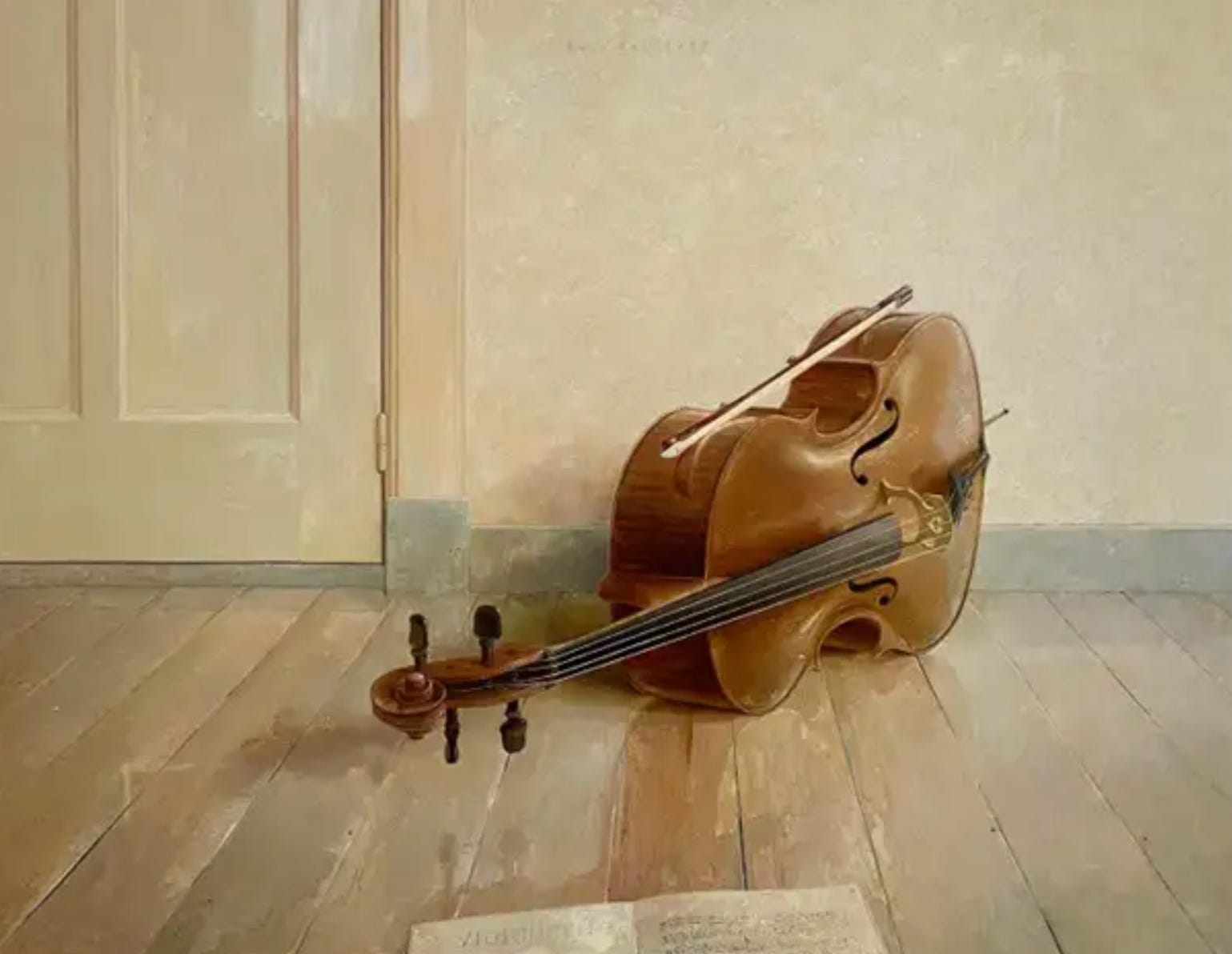
Allow me to suggest what I believe is a better metaphor: a bow needs a cello. Not to simply exist as a bow, certainly; nor even to become a better bow; but to accomplish the purpose, the telos, for which it exists in the first place. I think the ordinary man needs a wife in this sense. And it’s a sense which is equally incompatible with the egalitarian flattening of gender distinctions and the authoritarian prioritization of masculinity over femininity.
Which is more important, the bow or the cello? Which is more glorious? Which is supposed to be in charge? Does it matter whether the cello plays the bow or the bow plays the cello? The whole argument about equality vs. authority falls apart if we replace the atomized, individualistic focus on him and her with this picture. If the goal is to be independent we’re just two very different bits of wood and string. But if the goal is to become one instrument and make music to the glory of God, we’re each missing something critical that only the other can supply; and there is a necessary order to the way we must come together, which is in no way illuminated by arguments about equality.
Considered this way, we can see how the ancient understanding of masculine initiative and feminine response, which is so easily corrupted and perverted to justify the abuse and mistreatment of women by men, can be true, and good, and beautiful. In a good marriage, the Creator is the musician; when his bow and her cello are both submitted to the Musician’s will and obedient to His touch, the wonder of the music they make together will eclipse anything that they could ever have achieved singly. The whole will be infinitely better and greater than the sum of the parts.