Trad, Chad, or Cad?
Is it a patriarchy or just a tomcat? Honest question…

Our homeschooling family of 7 is between two moves and living out of boxes; it’s a chaotic season and I have consequently not posted for a while. I started this piece a few months ago after encountering a distinguished moron – on this platform, no less – who wrote, or at least published, a screed purporting to warn young men against the pitfalls inherent in dating “trad girls” because one is expected to put out a lot of effort, but may still be required to tie the knot before getting any sex in return. (This is perhaps an unfairly clear and concise summary of his drivel but it certainly portrays him in a better light than his own tiresomely self-focused and incoherent content.)
I laid it aside at a very rough draft stage in favor of other, more positive work, only to be reminded of it again and again these past few weeks. But over the weekend, Helen Roy drew my attention to a discussion that has rendered me furious enough to rewrite and publish it, for better or worse.
A few days ago an anonymous account calling itself The Doge Patriarch published a composition with the provocative banner, “Legalize raping your wife.” Nothing in that ragebait title would have induced me to read it, but I assumed that the post was about the dangers (and I grant that there are real dangers) inherent in marital rape laws, paired with a headline meant to drive engagement and traffic. I intentionally do not give time or attention to such content, on the assumption that if you have to stoop that low to get eyes on your work, it clearly isn’t worth my own limited time.
I did glance over the comment thread on Roy’s note. One disturbing thing stood out to me: the relative scarcity of male opposition to the dog patriarch’s initial article. Dozens of sensible female writers had perfectly natural reactions, from “In the name of all that is sane and holy, what is wrong with you?” to “Good luck with that, lonely jackass” (my paraphrasing). But there weren’t many men objecting at all. I know this is a common scenario and that there are good explanations for it, the most relevant one being that a majority of good men are too busy loving and providing for their families to follow mostly single, abysmally stupid online personalities who want to tell them how family life should work. But even if there were nothing objectionable in the article itself, any fool willing to use such a headline to draw traffic deserves an almighty smackdown from any decent men around him.
Then Monday morning I saw the original article shared approvingly by Michael Barros, a Catholic writer whom I have followed for some time. [Edited to add that Michael commented below, saying that his share was sarcastic and not an endorsement.] So I read the whole thing. And while I resent the necessity of even noticing an anonymous post that reads like ChatGPT composed it from prompts suggested by an alley cat-turned-ethicist, it does provide a perfect illustration for the subtle distinction implied in my subtitle.
What is patriarchy? Mary Harrington has argued somewhere that every modern, negative definition seems to “cash out as ‘immutable sex differences that I don’t like.’” That’s pretty accurate. I for one refuse to surrender the word to those who use it as a pejorative. Just as Harrington and Roy, along with other compelling and thoughtful thinkers like Leah Libresco Sargeant and Elizabeth Grace Matthew, continue to argue for a good and valuable feminism over against the destructive strains that predominate today, I will unashamedly argue that there is such a thing as good patriarchy, as well as a variety of destructive versions. Patriarchy means, not male dominance, but literally father-rule; I take the word merely to imply that within the sphere of family government there is a real and legitimate authority that inheres in the man of the house, as the father and, yes, as the husband. Those to whom that is automatically objectionable, who reject the claim that the position of father or of husband comes with any legitimate authority at all, will disagree with what else I have to say. But agreement on this baseline understanding still leaves open many questions regarding the nature of that authority and the manner in which it should be exercised.
Forty years ago, economist and sociologist George Gilder argued convincingly in Men and Marriage1 that male dominance on a societal level was an unavoidable fact of human existence, since men are by nature physically stronger, more aggressive, and have a higher capacity for violence than women. Gilder saw permanent, monogamous marriage as an institution uniquely capable of harnessing the destructive capacities of masculine energy for protective and constructive purposes. You might sum up his argument in the proverb, much older than Gilder: Men civilize the wilderness, but women civilize men. Louise Perry has more recently made a similar and equally persuasive case. But Perry has gone farther than Gilder, if I understand her correctly, in arguing that it was Christianity, or a Christianized patriarchy, that introduced the concept of equality between the sexes.
This is important, because the evolutionary psychology approach leads inevitably back to the old pagan view that might makes right; men rule because they can. In contrast, the Christian understanding of authority, not just in the family, but every kind of legitimate authority, is rooted not in the person but in the position, not in ability but in responsibility for the well-being of those who have been entrusted by God to one’s care. In the Christian understanding every authority figure, whether in the civil, the ecclesiastical, or the familial sphere, is merely a steward exercising delegated authority on behalf of Christ the High King, and is entrusted with that authority for the ultimate good of others, not for his own profit or pleasure. (C. R. Wiley’s excellent little book, In the House of Tom Bombadil2, is a delightful and thought-provoking exploration of this distinction, the difference between domination and dominion. I recommend it to you.)
But that’s a discussion for another day, because when it comes to sexual relations, the very concept of hierarchy is set aside. We need to be very careful here, because it is true that sexuality is inherently asymmetrical; it is true that within marriage (which is the only legitimate context for sexual relations in the first place), and especially in a good marriage relationship, the modern obsession with explicit consent is a bit of a lead balloon; and I do believe, with C.S. Lewis, that “obedience (humility) is an erotic necessity.”3 But that goes both ways. The concept of hierarchy is out of place in the marriage bed because St. Paul says so; sexuality is the one aspect of marriage where the Bible emphasizes an absolute equality of position.4 It is out of place because by its very nature sexual love is a gift, oneself offered to the other; and while each spouse has a real duty to give, neither has a right to take or to demand. Performance may be forced, but love cannot be taken, only given.
This is why neither the “personal autonomy” framework (a la Sheila Wray Gregoire), nor the “right to sex” framework, crudely exemplified by the dog patriarch but more subtly advanced in much “Christian” marriage literature of the past century, can do justice to good married sexuality as it was created and intended to be. A focus on “my rights” on the part of either spouse will always and invariably undermine the goodness and the beauty of the sexual relationship which lies at the heart of the marriage.
Note well what I do not say: that to assert one’s rights in a marriage is always wrong; I am saying only that something else must have already gone terribly wrong to make it necessary. A wife who is being coerced by her husband, or a spouse whose advances are chronically and unreasonably denied, should recognize that the issue is much deeper and much more serious than that point of conflict and will not be resolved by any possible outcome of the immediate dispute.
Sunday evening – after looking over the discussion involving Helen Roy, Georgi Boorman, and Jessica Wood, but before reading the dog patriarch’s original post on Monday – my wife and I watched The Nativity Story with our children, as we do every Christmas. I found myself reflecting as never before on the character of Joseph, as it struck me that at the heart of the central drama of redemptive history stands a godly man who married the woman he loved, and loved the woman he married, knowing that she would be off limits to him sexually.
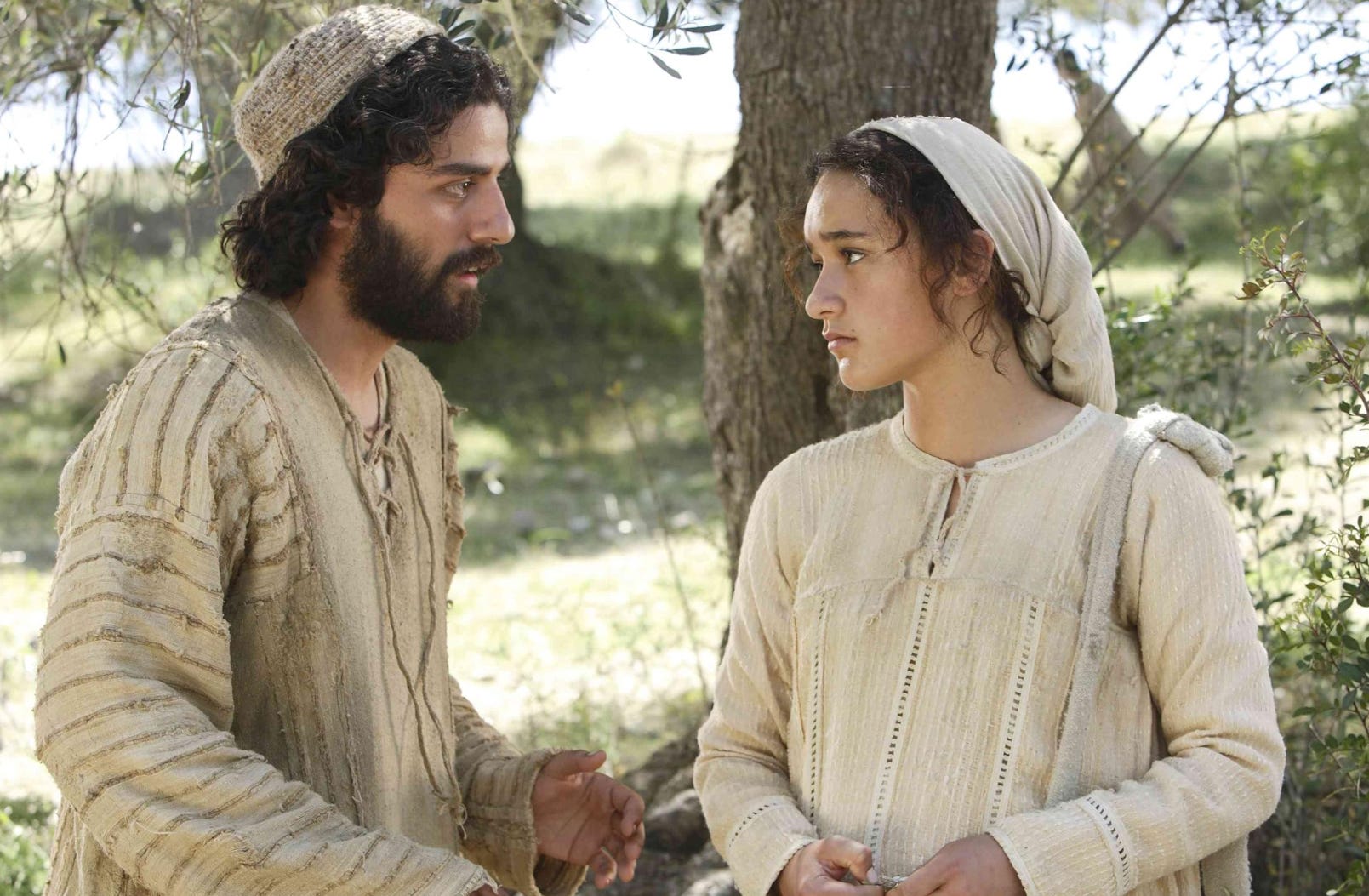
Think about that, guys. There’s a reflection powerful enough to be the Ghost of Christmas Never for a young man caught up in this destructive spiral of distrust and self-protection. Joseph was loving his wife as Christ loved the Church even before he had the benefit of Christ’s example to follow. You and I can do it too, by the grace of God.
For the record, I’ve failed this ideal many, many times as a husband. It remains nonetheless the only ideal to which I aspire.
A word to young men and women who are contemplating marriage. I can’t pretend, like the dog patriarch, to speak for women from experience; I’ve only known one woman in that way. A man who does presume to speak for women as women from experience is telling you something about himself that should be taken as a warning. But here’s what I have to say: if a man is looking forward to marriage but worried about the risk of being accused of marital rape, one of three things is true. Either he is a bully and knows it (in which case the lady should get out of Dodge fast); or he has the sense that the particular woman he wishes to marry is untrustworthy and manipulative (in which case he should get out of Dodge fast); or his perception of women as a group is that they are inherently untrustworthy and manipulative (in which case she should get out of Dodge, and he should get off the internet and go on a three-year retreat or pilgrimage or something to detox). In no case should a man marry if he is afflicted with the nagging fear that he might someday be accused of marital rape.
I was tempted to give more time to the dog patriarch’s post; there’s an old adage that says “it takes a lot of truth to float a lie,” and his hellishly destructive lie is floating on certain truths that it might be wise to acknowledge and address. But actually, no. It’s a reprehensible piece of garbage and does not deserve to be taken seriously except as mental and spiritual poison. It’s significant that the two examples of pop culture he appeals to are Fifty Shades of Grey and “Baby It’s Cold Outside” – which alone tells one everything necessary about the real mentality behind the words (hint: it ain’t Christian. At all.)
To accompany the post, he dug out of the entrails of the internet a photo of a half-naked man carrying a club, along with a seemingly unconscious woman, on his shoulders. It immediately made me think of Chesterton’s impassioned defense of the caveman’s character in Everlasting Man:
We are always told without any explanation or authority that primitive man waved a club and knocked the woman down before dragging her off. … When the psycho-analyst writes to a patient, “The submerged instincts of the caveman are doubtless prompting you to gratify a violent impulse,” he does not refer to the impulse to paint in water-colours, or to make conscientious studies of how cattle swing their heads when they graze. Yet we know for a fact that the caveman did these mild and innocent things; and we have not the most minute speck of evidence that he did any of the violent and ferocious things… The whole of the current way of talking is simply a confusion and a misunderstanding, founded on no sort of scientific evidence and valued only as an excuse for a very modern mood of anarchy. If any gentleman wants to knock a woman about, he can surely be a cad without taking away the character of the caveman, about whom we know next to nothing except what we can gather from a few harmless and pleasing pictures on a wall.5
Consider well, purveyors of evo-psych marriage advice.
Hilariously, autocorrect changed the word “cad” in the above quote to “cat” – serendipity, that. (I had already chosen and written the title and subtitle.)
We have a word in the English language for men like the dog patriarch and many of his commenters. It’s time to bring it back into everyday usage.
Pelican Publishing, 1986
Canon Press, 2021
C.S. Lewis, That Hideous Strength (I’ve loaned out my copy and cannot cite the page number, but the quote is from a conversation between Ransom and Jane Studdock.)
I Corinthians 7:3-4
G.K. Chesterton, Collected Works, Volume II (Ignatius Press, 1986), 159, 163.
Well said! The part about the christian understanding of authority reminded me ofna George Macdonald quote, from his book The Seaboard Parish. It's long but worth reading, I think.
> In America, the very name of servant is repudiated as inconsistent with human dignity. There is no dignity but of service. How different the whole notion of training is now from what it was in the middle ages! Service was honourable then. No doubt we have made progress as a whole, but in some things we have degenerated sadly. The first thing taught then was how to serve. No man could rise to the honour of knighthood without service. A nobleman’s son even had to wait on his father, or to go into the family of another nobleman, and wait upon him as a page, standing behind his chair at dinner. This was an honour. No notion of degradation was in it. It was a necessary step to higher honour. And what was the next higher honour? To be set free from service? No. To serve in the harder service of the field; to be a squire to some noble knight; to tend his horse, to clean his armour, to see that every rivet was sound, every buckle true, every strap strong; to ride behind him, and carry his spear, and if more than one attacked him, to rush to his aid. This service was the more honourable because it was harder, and was the next step to higher honour yet. And what was this higher honour? That of knighthood. Wherein did this knighthood consist? The very word means simply service. And for what was the knight thus waited upon by his squire? That he might be free to do as he pleased? No, but that he might be free to be the servant of all. By being a squire first, the servant of one, he learned to rise to the higher rank, that of servant of all. His horse was tended, this armour observed, his sword and spear and shield held to his hand, that he might have no trouble looking after himself, but might be free, strong, unwearied, to shoot like an arrow to the rescue of any and every one who needed his ready aid. There was a grand heart of Christianity in that old chivalry, notwithstanding all its abuses which must be no more laid to its charge than the burning of Jews and heretics to Christianity. It was the lack of it, not the presence of it that occasioned the abuses that coexisted with it.
Good to hear a man chime in and take this garbage out.